
Press releases
Media Release on Integrated Nuclear Infrastructure Review (INIR) Phase 1 Mission
19 May 2026
Singapore to Undertake IAEA Review by International Experts to Assess Its Ability to Make Informed Decision on Nuclear Energy Deployment.
Starting in 2027, Singapore will undertake an assessment by international experts to determine the country’s ability to make an informed decision on the potential deployment of advanced nuclear energy technologies in the future. The assessment is known as the Integrated Nuclear Infrastructure Review (INIR) Phase 1 Mission.
As part of efforts to assess the suitability of advanced nuclear energy technologies for power generation, Singapore has been progressively building capabilities in nuclear science, safety and technology in line with international best practices. The INIR Phase 1 Mission will support the Government in validating our progress and ensuring our capability development is advancing in the right direction, based on an internationally recognised assessment framework known as the International Atomic Energy Agency (IAEA) Milestones Approach.
The IAEA Milestones Approach comprehensively assesses 19 areas, such as capabilities to manage nuclear safety, radioactive waste, and emergency planning. The Approach reflects international best practices on nuclear energy deployment based on decades of international experience. More information on the IAEA Milestones Approach and INIR Mission can be found in Annex A.
The assessment via the INIR Phase 1 Mission will be a key milestone of Singapore’s nuclear capability building journey. The Mission will also enable the IAEA to better understand Singapore’s current stage of development and provide more tailored support for capability building efforts in the future.
Singapore has not made a decision on the adoption or deployment of nuclear energy. We will continue to monitor global developments and work with international partners to build capabilities in nuclear safety and regulation, as part of efforts to study all potential pathways for decarbonisation. Any decision to deploy nuclear energy will be carefully considered against its safety, reliability, affordability, and environmental sustainability in Singapore’s context.
ANNEX A
Factsheet on the IAEA Milestones Approach and INIR Mission
The IAEA Milestones Approach provides a structured, internationally recognised framework to guide countries in understanding the commitments and obligations associated with developing a nuclear power programme.
It defines key milestones a country must attain before constructing its first nuclear power plant, to ensure that necessary legal, regulatory, safety, security and technical foundations are in place. For each milestone, the IAEA Milestones Approach also outlines the phases that countries would need to go through, as shown in the diagram below:
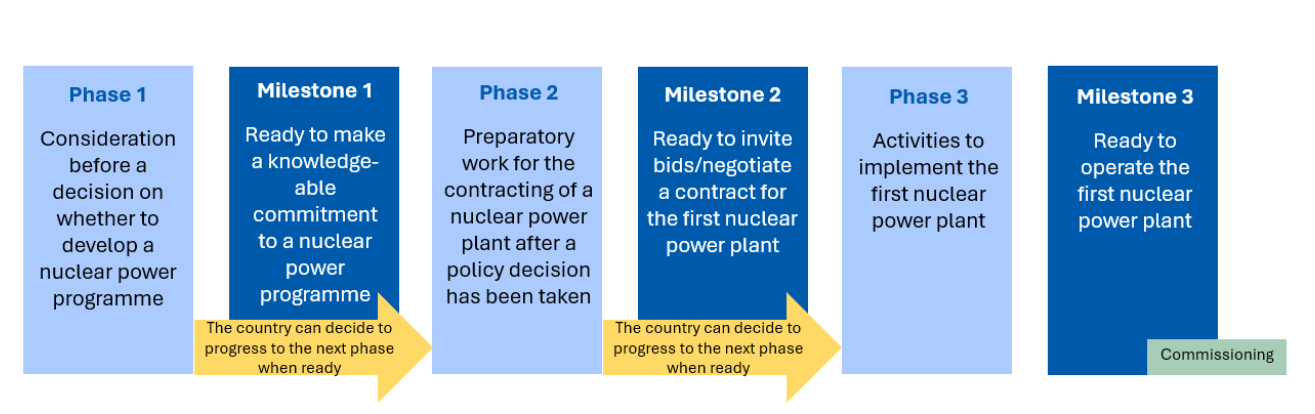
The Milestones Approach structures the development of a national infrastructure for nuclear power around 19 areas.
S/N | Area |
|---|---|
1. | National Position |
Nuclear safety | |
Management | |
Funding and financing | |
Legal framework | |
Safeguards | |
Regulatory framework | |
Radiation protection | |
Electrical grid | |
10. | Human resource development |
11. | Stakeholder involvement |
12. | Site and supporting facilities |
13. | Environmental protection |
14. | Emergency planning |
15. | Nuclear security |
16. | Nuclear fuel cycle |
17. | Radioactive waste management |
18. | Industrial involvement |
19. | Procurement |
The INIR Mission
The INIR is an independent and voluntary assessment by IAEA for countries considering to embark on or expand their nuclear power programme. It ensures that the national infrastructure required for the safe, secure and sustainable use of nuclear power is developed and implemented in a responsible and orderly manner.
There are three steps in the INIR Mission:
Step 1 (In Progress): Preparation of the Self-Evaluation Report (SER), which is a self-evaluation of the requesting country’s status of development with respect to the 19 areas.
Step 2 (tentatively 2027): Conduct of the main INIR mission, where the requesting country hosts a week-long plenary interview conducted by IAEA experts. The IAEA will publish key Mission findings right after the Mission.
Step 3 (tentatively 2027/2028): Finalisation of Mission Report, where the IAEA will detail its observations, recommendations and suggestions, which the country will use to develop a National Action Plan to chart out additional work required to reach Milestone 1. We intend to share the results of the INIR Mission to keep the public informed on our activities and strengthen Singaporeans’ understanding of nuclear energy.
Countries that have completed the INIR Phase 1 Mission can use the report findings to assess their readiness to make an informed decision on whether to adopt nuclear energy. Countries that have completed the INIR Phase 1 Mission include Estonia, Malaysia, Indonesia, the Philippines, Rwanda, Thailand and Vietnam. Not all countries that have completed the Phase 1 Mission have moved on to subsequent phases.
More information about the INIR missions that the IAEA has conducted for various countries can be found on their website: https://www.iaea.org/services/review-missions/integrated-nuclear-infrastructure-review-inir (opens in new tab)
ANNEX B
Understanding the Role of Nuclear Energy in Singapore’s Energy Transition
As a small and resource-constrained nation, Singapore takes a diversified portfolio approach to meet our growing energy needs, while pursuing net-zero carbon emissions by 2050.
Singapore’s strategy seeks to balance the need for energy security, sustainability and cost-competitiveness (“Energy Trilemma”), recognising that trade-offs are inevitable and no single solution is perfect.
Navigating the Energy Trilemma
Today, about 95% of Singapore’s electricity is produced using imported natural gas. This makes Singapore vulnerable to volatilities in the global environment, including fuel supply chain disruptions and energy price fluctuations. Natural gas is also a fossil fuel that produces carbon dioxide when burned.
Singapore is one of the most solar dense cities in the world. But even at its maximum deployment, solar will only meet less than 10% of Singapore’s electricity demand by 2050 due to land constraints. Sunlight is also weather dependent, hence requiring other energy sources or energy storage solutions to underpin energy supply reliability.
Singapore is working on importing electricity from other countries, such as Australia, Cambodia, Indonesia, Malaysia, and Vietnam. By 2035, one-third of Singapore’s electricity could come from imports. Renewable electricity supply from other countries is also weather dependent, and subject to supply chain disruptions.
Singapore cannot depend only on domestic solar and electricity imports to power Singapore. That is why Singapore is pursuing a portfolio of low-carbon energy sources, including studying nuclear energy, geothermal and hydrogen. The technologies to harness many alternative sources, however, are still nascent.
Potential Value of Advanced Nuclear Energy Technologies
Nuclear energy is a low-carbon energy source that has the potential to provide safe, reliable and cost-competitive electricity supply for Singapore.
Nuclear power plants can operate for extended periods without refuelling, providing a reliable source of baseload electricity while being less exposed to fluctuations in global fuel prices. This supports more stable electricity generation costs over the long term.
Advancements in technology have also improved the safety of nuclear systems. Singapore has been studying advanced nuclear technologies such as small modular reactors, which incorporate enhanced safety features without the need for human intervention or external power.
In addition, nuclear energy’s high energy density makes it a potentially suitable option for land-scarce Singapore. Five one-inch-tall uranium pellets – each smaller than an average thumb – can generate the same amount of energy as one Olympic-sized swimming pool of natural gas.
Nuclear energy has the potential to address Singapore’s energy security concerns while supporting our net-zero goals. Hence, we are rigorously studying its potential and closely monitoring the advancements in the nuclear energy space, so that we are ready to make an informed decision on the safe deployment of nuclear energy when the technology is ready.
However, any decision to deploy new energy technologies, including nuclear, will be carefully considered against their safety, reliability, affordability, and environmental sustainability in Singapore’s context.
Nuclear energy is a specialised field, and Singapore will continue to develop a wide range of capabilities to understand the technologies, potential benefits, risks and trade-offs.