
Press releases
Singapore and Rwanda Invite Invite Applications for Carbon Credit Projects under Bilateral Implementation Agreement
30 January 2026
Singapore and Rwanda have launched an application call for carbon credit projects under their Implementation Agreement on carbon credits cooperation.
Singapore and Rwanda have launched an application call for carbon credit projects under their Implementation Agreement on carbon credits cooperation. This is Singapore’s fourth call for project applications, following earlier calls under bilateral Implementation Agreements with Ghana, Peru and Bhutan.
Authorised projects will unlock additional carbon mitigation projects in Rwanda and advance both countries’ climate ambitions through targeted financing. These projects will promote sustainable development and benefit local communities through job creation, clean water access, improved energy security, and reduced environmental pollution.
Authorised projects can generate carbon credits aligned with Article 6 of the Paris Agreement. Under Singapore’s International Carbon Credit (ICC) Framework, these credits will be eligible for use by Singapore-based carbon tax-liable companies to offset up to 5% of their taxable emissions.
Interested parties may submit applications for their carbon credit projects in Rwanda to be authorised. Applications submitted will be reviewed by the Singapore and Rwanda governments.
Application and Authorisation Process
The application and authorisation process comprises three stages, each corresponding to a different stage of implementation for the carbon credit project (See Annex A). The first two stages require applicants to submit details on the design and implementation plan for the carbon credit project in the lead-up to project authorisation. The final stage is for corresponding adjustments to be applied to the carbon credits generated from the authorised project, in accordance with Article 6, Paragraph 2 of the Paris Agreement. Detailed steps on the application process can be found at Singapore’s Carbon Markets Cooperation website, at www.carbonmarkets-cooperation.gov.sg/overview-rwanda/.
Singapore and Rwanda will assess applications in accordance with each country’s respective requirements. For Singapore, these projects must meet Singapore’s eligibility criteria for ICCs. The eligibility criteria, and the list of eligible carbon crediting programmes and methodologies under the Singapore-Rwanda Implementation Agreement, are at Annex B, and on the Carbon Markets Cooperation website.
Annex A: Flowchart of Application and Authorisation Process
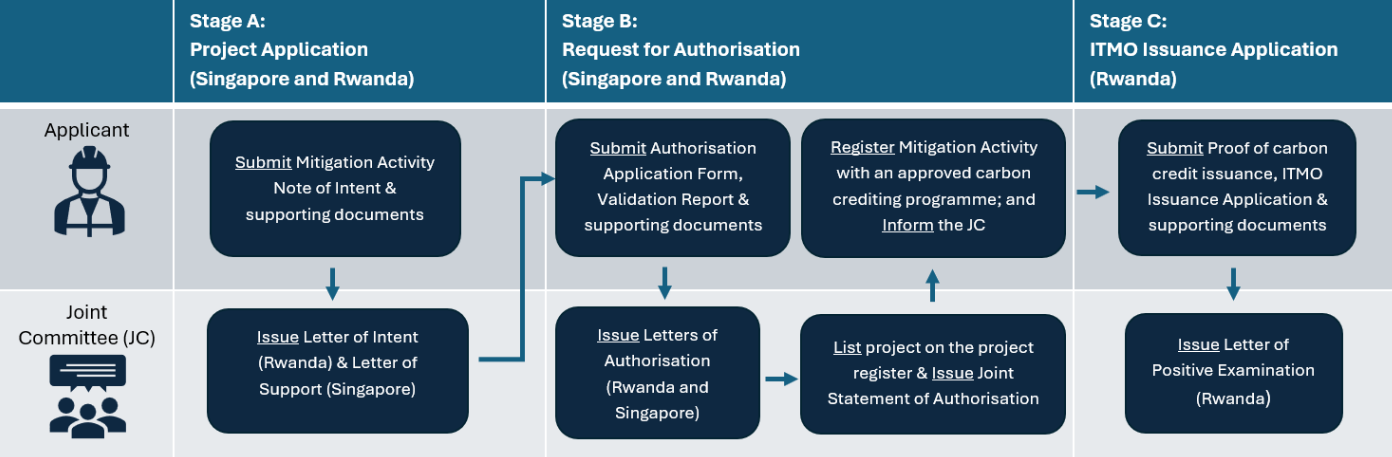
Joint Committee | The Joint Committee is the coordinating body that oversees administration of the Implementation Agreement. This committee under the Singapore-Rwanda Implementation Agreement is co-chaired by representatives from both countries: the Director of Carbon Planning Division of Singapore’s National Environment Agency, and the Deputy Director General of the Rwanda Environment Management Authority. |
Stage A: Project Application | Applicants must submit a concept note outlining their intended project. This document should specify the programme and methodology under which the project will be developed, and provide a broad explanation of how the project will be implemented whilst maintaining environmental integrity. |
Stage B: | Applicants are required to submit two key documents: a Project Design Document (PDD) and a validation report from a third-party auditor. The validation report must confirm that the project design meets all rules and requirements of the intended methodology and carbon crediting programme. Once Letters of Authorisation are received from both Singapore and Rwanda, the applicant should register the project with the intended carbon crediting programme and proceed to implementation. |
Stage C: | After the authorised project is implemented and emission reductions and removals have been verified by a third-party auditor, the carbon crediting programme will issue carbon credits to the project. Applicants must then submit a Proof of Issuance from the carbon crediting programme, accompanied by the verification report from the third-party auditor. This submission will be considered for corresponding adjustments to be applied to the issued carbon credits, in accordance with Article 6 of the Paris Agreement. |
Annex B: Singapore’s Eligibility Criteria and the Eligibility List under the Singapore-Bhutan Implementation Agreement
Eligibility Criteria
The Eligibility Criteria requires ICCs to represent emissions reductions or removals that occur within the timeframe specified under Article 6 of the Paris Agreement, and meet seven principles to demonstrate environmental integrity (see Table B-1 below).
Table B-1: Eligibility Criteria for ICCs
Principle | Definition |
To comply with Article 6 of the Paris Agreement, the certified emissions reductions or removals must have occurred between 1 January 2021 and 31 December 2030. | |
Not double-counted | The certified emissions reductions or removals must not be counted more than once in contravention of the Paris Agreement. |
Additional | The certified emissions reductions or removals must exceed any emissions reduction or removals required by any law or regulatory requirement of the host country, and that would otherwise have occurred in a conservative, business-as-usual scenario. |
Real | The certified emissions reductions or removals must have been quantified based on a realistic, defensible, and conservative estimate of the amount of emissions that would have occurred in a business-as-usual scenario, assuming the project or programme that generated the certified emission reductions or removals had not been carried out. |
Quantified and verified | The certified emissions reductions or removals must have been calculated in a manner that is conservative and transparent, and must have been measured and verified by an accredited and independent third-party verification entity before the ICC was issued. |
Permanent | The certified emissions reductions or removals must not be reversible, or if there is a risk that the certified emissions reductions or removals may be reversible, there must be measures in place to monitor, mitigate and compensate any material reversal of the certified emissions reductions or removals. |
No net harm | The project or programme that generated the certified emissions reductions or removals must not violate any applicable laws, regulatory requirements, or international obligations of the host country. |
No leakage | The project or programme that generated the certified emissions reductions or removals must not result in a material increase in emissions elsewhere, or if there is a risk of a material increase in emissions elsewhere, there must be measures in place to monitor, mitigate and compensate any such material increase in emissions. |
Eligibility List under the Singapore-Rwanda Implementation Agreement
The Eligibility List of carbon crediting programmes and methodologies in Table B-2 adhere to the Eligibility Criteria and meet the requirements of both Singapore and Rwanda. The carbon crediting programmes and methodologies that are eligible may be different for each host country, as host countries also have their own criteria.
Additional environmental integrity safeguards may be imposed for specific project types and/or methodologies. For more information, refer to the Singapore Carbon Markets Cooperation website.
Table B-2: Eligibility List specified under Annex A of the Singapore-Rwanda Implementation Agreement
Annex C: Information on the Singapore-Rwanda Implementation Agreement
Singapore and Rwanda signed an Implementation Agreement on carbon credits cooperation under Article 6 of the Paris Agreement in May 2025. Since the signing, Singapore has been working with Rwanda to operationalise the Implementation Agreement.
As an additional contribution to mitigation of global emissions, Singapore has committed to cancel 2% of the correspondingly adjusted carbon credits authorised under this Implementation Agreement at first issuance. These carbon credits cannot be sold, traded, or counted towards any country’s emission targets, and will instead contribute towards a net reduction in global emissions.
Singapore has committed to channel 5% of the value from correspondingly adjusted carbon credits authorised under this Implementation Agreement towards adaptation measures in Rwanda.
Singapore has 10 Implementation Agreements on carbon credit collaboration to date. This includes Implementation Agreements with Papua New Guinea, Ghana, Bhutan, Chile, Peru, Rwanda, Paraguay, Thailand, Vietnam, and Mongolia.
Effective international cooperation in carbon markets is an important part of Singapore’s efforts to achieve net zero emissions by 2050, given Singapore’s national circumstances as an alternative-energy disadvantaged country with limited domestic mitigation potential.